Two Big Jackpots, Zero Winners — and the Rumors That Follow
Every time a PCSO draw ends with nobody hitting the jackpot, the same conversations light up group chats across the country. Somebody insists the draw was "controlled." Somebody else swears their suki at the lotto outlet already knew which numbers were coming. And at least one person will claim that certain combinations are "impossible" because they have never appeared in years of play.
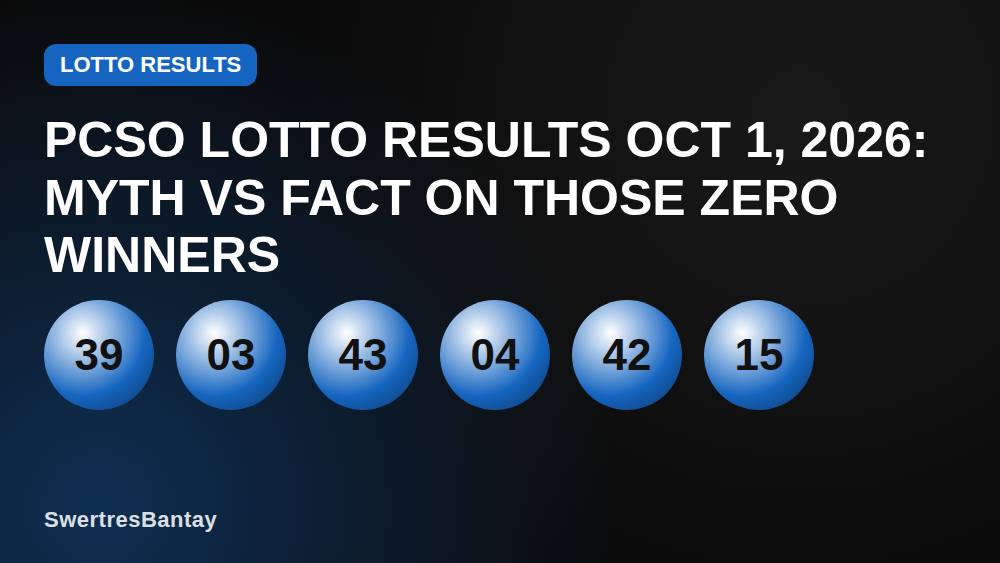
The October 1, 2026 results give us a perfect case study. Superlotto 6/49 carried a jackpot of ₱30,902,608.81 and produced no grand prize winner. Lotto 6/42 was even heavier at ₱71,399,823.97 — also with zero jackpot hits. Meanwhile, the smaller games behaved exactly the way you would expect: 3D and 2D draws across all three daily schedules paid out to hundreds of bettors, including 612 winners in the 9PM 3D draw alone.
So which is it? A rigged system, or just math doing what math does? Let us walk through the actual numbers from last night and apply a healthy dose of skepticism to the myths that keep circulating.
| Game | Winning combination | Jackpot (PHP) | Winners |
|---|---|---|---|
| Superlotto 6/49 | 39-03-43-04-42-15 | 30,902,608.81 | 0 |
| Lotto 6/42 | 40-13-35-10-15-14 | 71,399,823.97 | 0 |
| 6D Lotto | 0-5-9-3-4-8 | 593,359.76 | 0 |
| 3D Lotto 2PM | 7-4-6 | 4,500.00 | 132 |
| 3D Lotto 5PM | 0-3-2 | 4,500.00 | 73 |
| 3D Lotto 9PM | 4-2-9 | 4,500.00 | 612 |
| 2D Lotto 2PM | 14-09 | 4,000.00 | 139 |
| 2D Lotto 5PM | 24-15 | 4,000.00 | 65 |
| 2D Lotto 9PM | 23-21 | 4,000.00 | 93 |
The Complete PCSO Results for October 1, 2026
Here is the full slate from Thursday's draws, including jackpot amounts and the number of winners per game. The table above is your reference point for everything that follows — no need to memorize it, just note the pattern of zeroes in the top two rows.
What stands out immediately is the contrast. The two major lotto games — Superlotto 6/49 and Lotto 6/42 — both rolled over. The digit games, by contrast, were busy: 132 winners in the 2PM 3D draw, 73 in the 5PM, and a hefty 612 in the 9PM. The 2D games followed the same rhythm with 139, 65, and 93 winners respectively across their three schedules.
That split is not a coincidence, and it is not evidence of anything fishy either. It is simply the difference between picking six numbers out of a large pool and picking two or three digits from a much smaller one. We will get into the specifics shortly.
Myth: "Walang nanalo, so the Draw Was Fake"
This is the most persistent belief in Philippine lotto culture, and it resurfaces reliably every time a jackpot rolls over. The logic goes: if the prize is that big and nobody won, something must be wrong.
Here is the fact. In Superlotto 6/49, the odds of hitting the jackpot with a single ticket are 1 in 13,983,816. In Lotto 6/42, they are 1 in 5,245,786. When you consider that even a well-attended draw might sell a few hundred thousand to a few million combinations — and that many players pick overlapping "lucky" numbers — the probability of at least one winner is far lower than most people assume.
Zero winners is not a red flag. It is the single most statistically likely outcome for any individual major lotto draw.
Think of it this way: if 5 million distinct 6/42 combinations are in play and there are 5,245,786 possible outcomes, you are still looking at a coin-flip-ish scenario at best, and most draws do not see anywhere near full coverage. Rollovers are the norm, not the exception. That is precisely why jackpots grow the way they do.
Myth: "There Are Hot and Cold Numbers You Can Track"
Scroll through any Facebook group for lotto enthusiasts and you will find spreadsheets, color-coded charts, and passionate arguments about which numbers are "due" to appear. The October 1 draws gave these analysts plenty of material to argue over.
Look at the 3D 9PM result: 4-2-9, which pulled 612 winners — the highest count of the night by a wide margin. Does that mean 4, 2, and 9 are "hot"? Not in any predictive sense. It means that particular combination happened to be a popular pick, possibly because those digits correspond to birthdays, anniversaries, or simply a pattern that felt right to a lot of people at the same time.
The fact is that each PCSO draw is an independent event. A number appearing on October 1 has exactly the same chance of appearing on October 2 as any other number. Past frequency does not influence future probability. What the winner counts in the table actually tell you is something different and more interesting: they reveal how popular certain combinations are among players, not how likely they are to come up.
This is a meaningful distinction. If you deliberately avoid the most popular combinations — the ones tied to dates and easy patterns — you are not increasing your odds of matching the winning numbers, but you are increasing the size of your share if you do win. Fewer co-winners mean a bigger slice of the jackpot.
Myth: "Buying More Tickets Guarantees a Win Sooner or Later"
This one has a kernel of truth buried under a mountain of misunderstanding. Yes, buying more combinations does increase your probability of winning — mathematically, each unique combination is another chance. But the scale of the increase is what people consistently misjudge.
Buying ten tickets in Lotto 6/42 takes your odds from 1 in 5,245,786 to 10 in 5,245,786. That is 1 in roughly 524,579. Better, certainly, but still extraordinarily unlikely. Buying a hundred tickets gives you 1 in about 52,458. You would need to buy millions of combinations to approach a meaningful probability, and at ₱20 per play, the cost quickly exceeds the jackpot value in expected terms.
There is also no "streak" mechanic. The machine does not remember that you have been playing for three years and decide to reward your loyalty. Every draw resets to zero. The gambler's fallacy — the belief that you are "due" because you have been losing — is probably the single most expensive myth in lottery culture.
What the Digit Games Actually Tell Us
The 3D and 2D results from October 1 offer a useful contrast to the major lotto games, and they deserve more attention than they usually get.
In 3D Lotto, you are picking three digits from 0 to 9, and the order matters. That gives you 1,000 possible combinations. With a fixed prize of ₱4,500 per winning bet, the payout structure is straightforward. When 612 people win the 9PM draw, it tells you that a genuinely large number of players converged on the same three digits — 4, 2, and 9.
The 2D games are even simpler: two digits, order matters, 100 possible combinations, ₱4,000 fixed prize. The October 1 results saw 139 winners in the 2PM draw (14-09), 65 in the 5PM (24-15), and 93 in the 9PM (23-21).
- Popularity clustering is real. Notice how the 9PM draws consistently attract more winners than the earlier schedules. Evening draws have larger player volume, which naturally produces more winners even when the combination is not especially "lucky."
- Fixed prizes mean no dilution. Unlike the major lotto games where multiple jackpot winners split the pot, 3D and 2D pay a flat rate regardless of how many people win. Your ₱4,500 is your ₱4,500.
- Lower variance, lower ceiling. The trade-off is obvious. You will win far more often in digit games, but you will never walk away with ₱71 million.
The 6D Lotto and the Middle Ground Nobody Talks About
Sitting quietly between the major lotto games and the digit games is 6D Lotto, which on October 1 produced the combination 0-5-9-3-4-8 with a jackpot of ₱593,359.76 and zero winners.
6D occupies an odd space in the PCSO lineup. It is simpler than picking six numbers from a pool of 49, but the prize is not fixed like 3D or 2D. The jackpot accumulates, and the odds — 1 in 1,000,000 — sit in a middle zone that many players find appealing.
Zero winners here is entirely unremarkable. With a million possible combinations and a much smaller player base than the headline lotto games, rollovers are common. What makes 6D interesting is that the smaller jackpot size means it occasionally gets hit, and when it does, the winner count is usually just one or two people. That is a different kind of appeal from the dream of a ₱71 million payday.
How to Read These Results Without Falling for the Noise
If you are going to follow PCSO results seriously — whether for curiosity, record-keeping, or because you genuinely enjoy the game — here is a practical framework for making sense of a draw like October 1, 2026.
- Separate jackpot rollovers from anomalies. No winner in 6/49 or 6/42 is routine. Ask yourself whether the outcome is statistically surprising before reaching for a conspiracy theory.
- Use winner counts as a popularity signal. A high winner count in 3D or 2D means the combination was widely picked. That information is useful for understanding player behavior, not for predicting the next draw.
- Check the payout structure, not just the jackpot. A ₱71 million jackpot that gets split five ways is very different from one claimed by a single winner.
- Treat every draw as independent. No result on October 1 changes the probability on October 2. Full stop.
- Set a budget before you play. This is the only "strategy" that reliably improves your outcome, because it limits the damage when the math goes against you — which it usually will.
The Real Reason Rollovers Happen So Often
It is worth putting the two major rollovers into perspective because it explains so much about how lotto actually works.
Superlotto 6/49 at ₱30.9 million and Lotto 6/42 at ₱71.4 million both going unclaimed on the same night is not dramatic. It is typical. Major lotto jackpots roll over dozens of times before being hit. The jackpot grows precisely because nobody wins — that is the design. If someone won every draw, the prize would never climb past the minimum guaranteed amount.
The Philippine Charity Sweepstakes Office publishes complete draw results, including winner counts, precisely so that the public can verify outcomes. That transparency is the strongest argument against the rigging myths. If draws were being manipulated, you would expect to see patterns in the data — impossible sequences, winner counts that do not track with player volume, jackpots that never get claimed. Instead, what you see is exactly what probability theory predicts: mostly rollovers, occasional hits, and digit games paying out steadily to hundreds of players at a time.
None of this makes the lottery a smart financial decision. The expected value of a ticket is negative, and no amount of pattern analysis changes that. But there is a difference between acknowledging the house edge and believing the game is fraudulent. One is math. The other is a myth.
What to Watch Going Into the Next Draws
With both major jackpots rolling over, the next few draws will see increased player interest — and that has real consequences worth understanding.
Bigger jackpots attract more bettors. More bettors mean more combinations in play, which slightly increases the chance that someone wins. But it also means that if you do win, you are more likely to share the prize. The sweet spot for a solo jackpot is usually a draw with a decent prize pool but relatively modest player turnout — a nuance that most casual players never consider.
For the digit games, the dynamics are simpler. Volume will remain steady, popular combinations will continue to draw large winner counts, and the flat prize structure means your payout does not change based on how many others picked the same numbers.
Whatever you decide to play — or whether you decide to sit this one out — the October 1 results are a useful reminder that the lottery is a game of probabilities, not predictions. The table above is not a roadmap. It is a receipt. Treat it as a record of what happened, not a hint about what comes next.