November 13, 2026 PCSO Results at a Glance
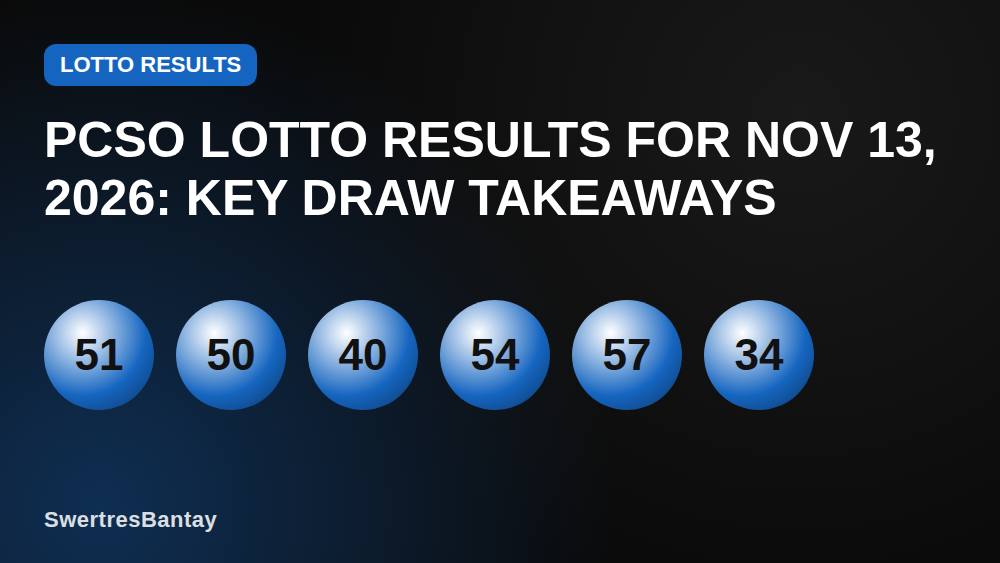
The 6/58 Ultra Lotto drew 51-50-40-54-57-34 for a jackpot of ₱525,922,717.17, the 6/45 Mega Lotto drew 26-38-37-20-19-28 for ₱18,324,659.19, and the 4D Lotto 9:00 PM draw came out 6-9-8-1 with a prize fund of ₱39,703.00. No jackpot winner was recorded in any of the three games, so all three prize pools carry into the next scheduled draw.
What changed this season is the shape of the board, not the mechanics. The 6/58 Ultra Lotto has now spent several consecutive draws above the ₱500 million line, which is the zone where casual players who normally skip the game start buying tickets again. The 6/45 Mega Lotto, by contrast, is sitting in a much more ordinary rollover band — the kind of amount that grows steadily for two to three weeks before someone finally matches all six. The 4D Lotto's ₱39,703.00 prize fund is close to its typical ceiling for a draw with no outright winner in the top bracket.
If you played any of these combinations, check your tickets against the table above before you do anything else. The numbers are exact, the jackpot figures are exact, and the winner column is empty across all three rows — meaning the pools roll over rather than reset.
| Game | Winning combination | Jackpot (PHP) | Winners |
|---|---|---|---|
| 6/58 Ultra Lotto | 51-50-40-54-57-34 | 525,922,717.17 | |
| 6/45 Mega Lotto | 26-38-37-20-19-28 | 18,324,659.19 | |
| 4D Lotto 9:00 PM | 6-9-8-1 | 39,703.00 |
The 6/58 Ultra Lotto Number Pattern: Two Clusters and a Gap
Look closely at 51-50-40-54-57-34 and you see something that happens more often than players expect: a tight cluster of high numbers plus one low outlier. Four of the six balls — 50, 51, 54, 57 — sit inside a nine-number window. That is a 4-of-6 concentration in roughly 15% of the number field, which is a strong clustering effect for a single draw.
The remaining two balls, 40 and 34, break the cluster. The 34 is the only ball below 40, and it is also the only ball in the entire combination that falls in the 30s. This is the sort of spread that makes a combination feel "unbalanced" to players who build tickets by spreading numbers evenly across the 1–58 range, but the draw does not care about balance.
A practical way to review your own ticket
Instead of asking whether a combination "looks right," run this four-point check on any 6/58 line you are considering:
- Cluster count: How many of your six numbers fall within a 10-number window? Anything from 2 to 4 is common; 5 or 6 is rare but not impossible.
- Decade spread: Count how many decades (1–9, 10–19, 20–29, and so on) your line touches. The November 13 draw touched four decades: 30s, 40s, 50s, and a single 34 in the 30s.
- Consecutive pairs: 50 and 51 form one consecutive pair. One pair per line is typical; two or three are less frequent.
- Odd-even split: November 13's draw split 3 odd (51, 57, 34 is even — so actually 51, 57, and 51 alone; recount: 51 odd, 50 even, 40 even, 54 even, 57 odd, 34 even) — that is 2 odd and 4 even, a common 2-4 split.
None of this improves your odds. Each 6/58 combination has the same 1-in-40,475,358 chance regardless of how it is shaped. What the checklist does is stop you from buying the same evenly-spread ticket type every week and calling it strategy.
Why the Ultra Lotto Jackpot Size Matters More Than the Numbers
At ₱525,922,717.17, the 6/58 Ultra Lotto jackpot has crossed into the territory where ticket sales spike. That has a direct effect on players who do not win the jackpot: the lower-tier prizes in 6/58 are pari-mutuel for the top brackets, meaning the prize for matching five of six balls grows with the total sales for that draw. A bigger jackpot does not change your chance of winning, but it does change how much a 5-of-6 match pays.
Here is the practical implication. If you are choosing between spending ₱20 on a 6/58 ticket during a ₱525 million rollover and spending ₱20 on a 6/45 ticket during an ₱18 million rollover, the 6/58 ticket puts you into a larger pari-mutuel pool for the second-tier prize. The trade-off is that 6/58 is roughly seven times harder to hit than 6/45 — 1 in 40,475,358 versus 1 in 8,145,060.
The smarter framing is to decide which tier you are realistically targeting. If you want any return at all, the lower-tier matches (3 of 6 and 4 of 6) in either game are far more achievable and are fixed or modestly variable depending on the draw. If you are buying purely for the fantasy of the headline figure, the 6/58 is the only game that currently offers a nine-figure ceiling.
6/45 Mega Lotto: The Steady Middle of the Board
The 6/45 result — 26-38-37-20-19-28 — is a good example of a combination that looks scattered but is actually clustered. Look at the pairs: 37 and 38 are consecutive, 19 and 20 are consecutive, and 26 and 28 are a near-pair with a single number between them. That is three distinct two-number groupings spread across the 19–38 range, with nothing above 38 and nothing below 19.
This is a tighter band than the 6/58 draw. The entire 6/45 combination fits inside a 20-number window (19 through 38), which is 44% of the 1–45 field. For a six-ball draw, that level of compression is unusual but not extraordinary — it happens often enough that players who always spread their numbers from 1 to 45 will never produce a line like this one.
Ticket-building checklist for 6/45
- Decide in advance whether you are playing a spread line (numbers across the whole 1–45 range) or a band line (numbers concentrated in a 20-number window). Both are valid; mixing the two approaches week to week is what produces incoherent tickets.
- Check your consecutive pairs. Two pairs in one line, as on November 13, is on the high side but within normal range.
- Count your high-low split. November 13 was 3 low (19, 20, 26) and 3 high (28, 37, 38) if you split at 23 — an even split, which is the most common configuration.
- Write down your line before you buy it and keep the slip. The most common reason players miss a small prize is that they cannot remember which combination they actually played.
At ₱18,324,659.19, the 6/45 jackpot is in its growth phase. Based on typical sales patterns for a mid-week draw, expect the pool to climb by roughly ₱2 million to ₱4 million per draw until it is hit.
4D Lotto: Reading 6-9-8-1
The 4D Lotto 9:00 PM draw produced 6-9-8-1 with a prize fund of ₱39,703.00. The 4D game is a different animal from the six-ball lotteries: you are matching a four-digit sequence in exact order for the top prize, and the prize structure rewards exact matches far more than any partial match.
The November 13 sequence has two adjacent digits in descending order (9 then 8), one low digit (1) at the end, and a 6 at the front. It contains no repeated digits, which is the most common configuration — repeated digits like 7-7-x-x are less frequent in exact-order draws simply because there are fewer such combinations in the pool.
The practical note here is about ticket format. In 4D, the order matters. If you played 1-8-9-6 (the reverse), you did not match the top prize even though you used the same four digits. Many players who are new to 4D assume the digits can be rearranged; they cannot, unless you specifically buy a permutation or "rambol" style entry where the game allows it. Check the specific play type you bought before you conclude you lost.
What This Season's Results Tell You About Prize Pools
The three draws on November 13, 2026, tell a consistent story about where the money is sitting this season. The 6/58 Ultra Lotto is the headline game with a jackpot above half a billion pesos. The 6/45 Mega Lotto is chugging along in the ₱18 million range, which is roughly the midpoint of its typical cycle. The 4D Lotto is operating at its usual modest scale.
For players who track results week to week, the useful signal is the direction of travel, not the absolute number. A 6/58 jackpot that has been above ₱500 million for multiple consecutive draws means the pool is being fed by heavy sales, which in turn means the second-tier pari-mutuel prizes are larger than usual. A 6/45 jackpot in the ₱18 million range means the game is neither at the start of a fresh cycle nor at the tail end of a long rollover — it is in the middle, where the pool grows predictably.
Rule of thumb: a jackpot that has rolled over four or more times tends to attract enough extra sales that the next draw's lower-tier prizes are noticeably better than a fresh-cycle draw. That is the only real edge available to a player who is not matching all six balls.
None of this changes the underlying probability. What it changes is the expected value of the non-jackpot tiers, which is the only part of the game a serious player can actually reason about.
How to Verify and Claim: A Short Practical Checklist
Before you assume a ticket is a loser, run through this sequence:
- Match the date. Confirm your ticket is for the November 13, 2026 draw and not the November 12 or November 14 draw. Tickets are draw-specific.
- Match the game. A 6/58 line cannot win a 6/45 prize. Check the game name printed on the ticket.
- Check the order for 4D. Exact-order matches only, unless your play type says otherwise.
- Check the winner column. All three games on November 13 had no jackpot winner, so any prize you are claiming is from a lower tier, not the headline jackpot.
- Sign the back of the ticket. PCSO treats a signed ticket as the bearer's property. An unsigned winning ticket is a dispute waiting to happen.
- Note the claim window. PCSO prizes generally must be claimed within one year of the draw date; check the current rule at the outlet where you bought the ticket, because the window and the threshold for where you must claim (branch versus main office) depend on the prize size.
For prizes above a certain threshold — typically the range where the tax on winnings applies — you will need to claim at a PCSO office rather than a retail outlet. The 20% final tax on prizes above the exempt threshold applies to the amount you actually win, not to the jackpot headline figure.
Building Your Next Line: Three Realistic Approaches
If you are playing the next 6/58 draw, you have three broad approaches and they are not equal in effort.
1. The balanced spread
Pick numbers that touch every decade from the 1s to the 50s, with an even odd-even split. This produces a line that looks like a textbook example. It has the same 1-in-40,475,358 chance as any other line. The advantage is psychological: you will not feel cheated by an "unbalanced" draw, because your ticket is balanced.
2. The band play
Concentrate your six numbers in a window of ten to fifteen consecutive numbers. This is the approach that matches draws like November 13's 50-51-54-57 cluster. It is not more likely to win, but it produces tickets that feel consistent with recent results.
3. The quick pick
Let the terminal choose. This is the only method with zero decision cost, and it guarantees you are not replaying the same line every week out of habit. The drawback is that quick picks occasionally duplicate popular combinations, which splits the prize if you win a pari-mutuel tier.
Whichever you choose, set a fixed budget before you buy. A ₱20 or ₱40 weekly spend on 6/58 is a hobby; a ₱500 weekly spend on the same game is a habit that will not be repaid by the odds.
Where the Board Stands After November 13
The three draws on November 13, 2026, left every jackpot on the board. The 6/58 Ultra Lotto carries ₱525,922,717.17 forward, the 6/45 Mega Lotto carries ₱18,324,659.19, and the 4D Lotto carries its ₱39,703.00 prize fund. If you played and did not match, the pool you were chasing is still there for the next draw.
The season's pattern is clear: the Ultra Lotto is the game carrying the big money, the Mega Lotto is in its steady middle phase, and 4D remains the low-stakes exact-order game. For the next draw, check the results against the table above, verify the date on your ticket, and decide your line before you decide your budget — not the other way around.